22 October 2026
As a Julian Oblate, I take the same vows that the nuns living in community at the Wisconsin motherhouse take, and that have been common in Western monasticism since the time of St. Benedict: stability, conversion of life, and obedience. Our vows differ not in degree, but only in disposition.
To the casual observer, two of the vows in particular, stability and conversion of life, often seem contradictory. Stability implies constancy and permanence, while conversion would seem to require evolution and mutability. They seem to pull in opposite directions, distracting and diverting us rather than pointing toward a unified goal. What I have found in monastic life, however, is that, far from interfering with each other, they complement one another and give rise to a creative tension. Contrasting things can be true at the same time, and wrestling with that paradox fertilizes true growth and maturity. Stability anchors and grounds us, while conversion of life gives us the aspirational growth mindset to strive to be better disciples of Christ every day. Each monastic order has its own charism, its particular focused vocation. Its members are called not to be jacks-of-all-trades, but to go deep into the unique mission God has given them.
Going deeper is an apt and timely theme, not only for our stewardship campaign, but for all of us seeking to become more faithful followers of Jesus. The world at large, with its social media influencers and shrinking attention spans, is heading in the opposite direction, and that may be the best confirmation that depth, rather than superficial breadth, is the way to go. For our acolytes, it has meant asking what it would look like to deepen the spirituality of serving at the altar.
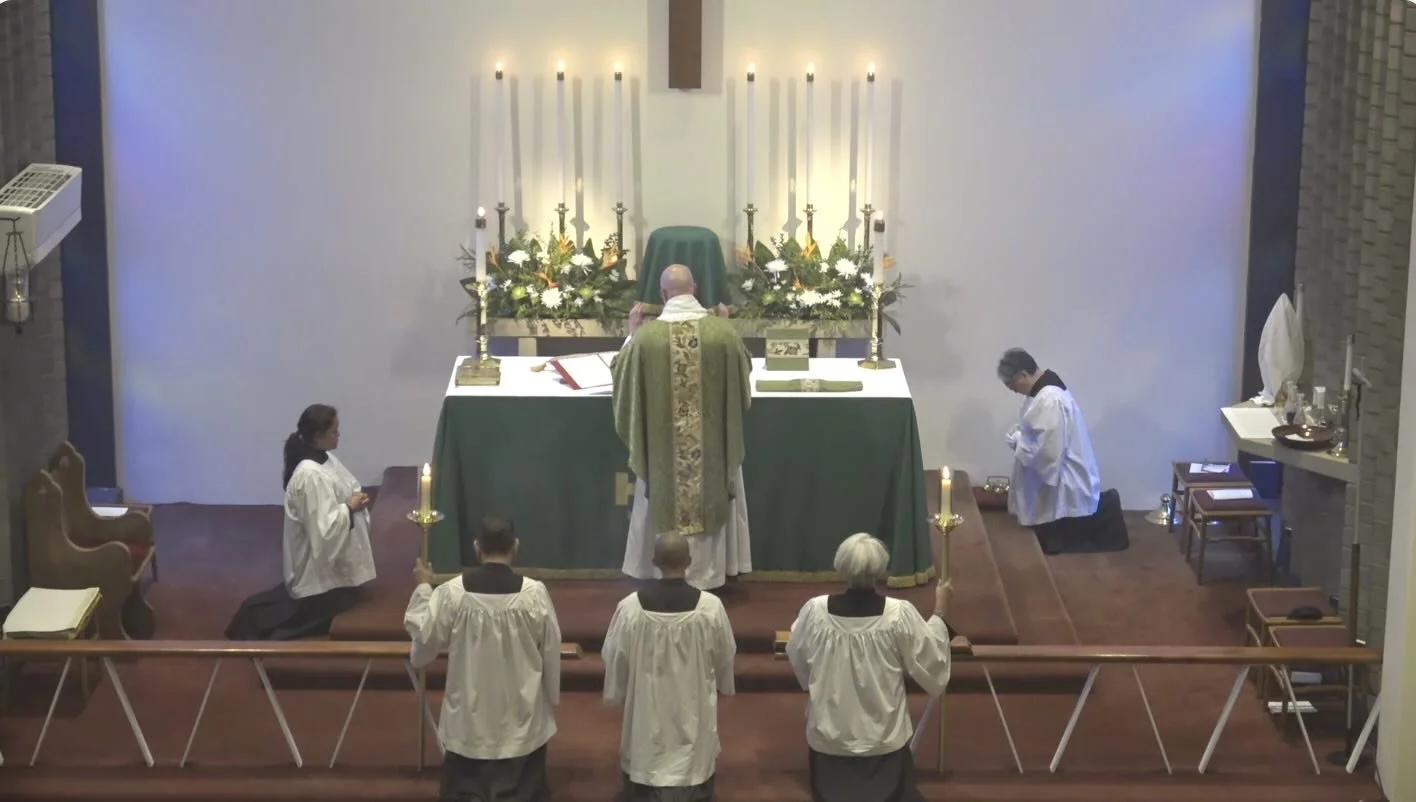
Those of us who serve at the altar participate in a very visible ministry, yet our ultimate goal is to become invisible. The liturgy is not a performance, and we are not its stars. Done well, our service is inconspicuous and unobtrusive, quietly facilitating our communal worship of God. That requires attention to detail, alertness, knowledge of the liturgy, and enough aplomb to recover gracefully when things do not go quite as planned. Most of all, it requires both stability and conversion of life. We need a stable core of acolytes willing to commit to serving week in and week out, and to become a community that complements and cares for one another. And we need acolytes committed to lifelong liturgical learning and, most importantly, to deepening the spirituality that underpins our service.
Serving at the altar is more than showing up five minutes before the service, hurriedly tossing on vestments, going through the liturgical motions on autopilot, and hurriedly shedding those same vestments as the postlude winds down. As liturgical leaders, we are called to model something deeper. You may have noticed that before every Mass there are liturgies and devotions that help us move from the secular to the sacred: the rosary on Sundays, Vespers on Saturday evenings, and Adoration on Wednesday evenings. All of us, not only altar servers, can benefit from taking part in them as we prepare ourselves for sacramental worship.
In that same spirit, our acolyte corps has established a parish chapter of the Order of St. Vincent (OSV), a worldwide fellowship of lay ministers and altar servers devoted to liturgical service, care for the sanctuary, and traditional ritual. The Order traces its roots to a guild formed at St. Clement's Church in Philadelphia in 1877. Though grounded in Anglican and Episcopal tradition, it is a trans-Catholic order that welcomes lay ministers from across the spectrum of Western-rite liturgical churches. Our King Kamehameha IV and Queen Emma Chapter will follow the Order's rule of life, centered on prayer, scripture reading, regular worship, and sacramental participation. Being a Julian Oblate has given me both a supportive community and a formal framework for my own life of prayer. Similarly, the chapter will give our servers a framework for lifelong formation in liturgical leadership, a charism of our own.
Stability and conversion of life, then, are not only monastic vows. They describe what we hope for every member of our parish this stewardship season: to stay rooted in the life of this community, and to let that life keep changing us. For our acolytes, the Order of St. Vincent is one concrete way of going deeper. We will soon celebrate the chapter's founding with a public induction of our first members. I hope you will join us, both to pray for those who serve at the altar and to consider where God may be inviting you to go deeper yourself.
Brother Michael Ida
Oblate of the Order of Julian of Norwich